The Philosopher Eric Levergois’s Essay About Cristina Rodriguez’s Painting "The Parrot of Shepherd’s Bush"
Le Perroquet Dans Sheperd’s Bush
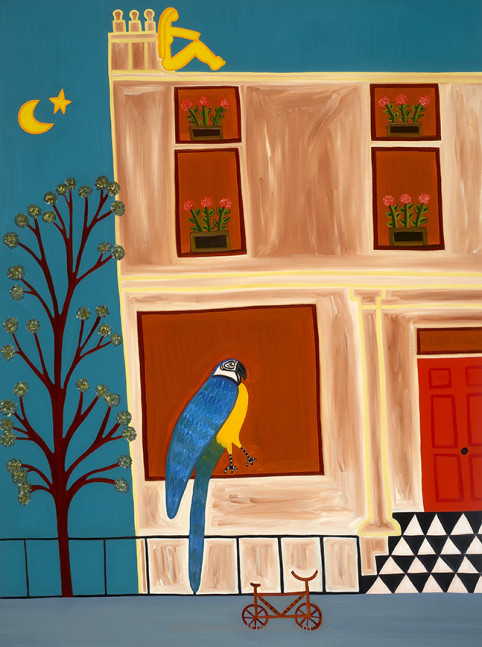
Le perroquet qui occupe la place centrale est un passager qui s'attarde avec un air de philosophe savant. Il est une partie d'un monde bien à lui, plus grand que les proportions des immeubles qui sont au fond, comme souvent chez l' artiste. Contrairement à l'élégance fastueuse des perroquets, celui-ci est couleur de canard un peu sobre : habillé pour une visite du soir avec une élégance mesurée. On se demande s'il est venu converser et non répéter seulement ce qu'il entend. Ses pattes montrent qu'il n'est ni posé, ni perché. Dans son imagination visionnaire, Cristina Rodriguez représente en intentions rêvées, la maison, l'arbre, la barrière, déplacés et disjoints, un peu éloignés les uns des autres et chacun possédant son rêve intérieur – c'est une donnée essentielle de penser que tout élément songe, bien à part dans un espace à lui, sans renoncer au reste, mais exerçant sa présence dans un îlot qui émerge, avec sa couleur, son charme, sa puissance et son élan indépendants. Ainsi toute toile peut être un conte laissé à portée de notre imagination : l'enfant sur le toit va peut-être prendre le vélo, le perroquet s'avancera et entrera peut-être par une fenêtre , on s'y attend, en proie à la surprise, et la fable est une série de cartes à rejouer. Au cœur de cette attente d'une conclusion, nous participons aux rêves peints qui nous attirent. Et nous demeurons sous le charme, fascinés, comme devant des personnages de lanterne magique qui ont suspendu leur course et dont le parcours nous appelle en insistant.
Eric Levergeois
Philosophe
2015
The Parrot of Shepherd’s Bush
Translated by Dr. Ariane Galy (2024)
Occupying centre stage, the parrot lingers with the look of a knowing philosopher. Characteristic of Cristina Rodriguez’s paintings, our protagonist is part of a world that belongs only to him: here, he is disproportionately larger than the buildings behind him, and instead of possessing the usual fastidious elegance of parrots, this one’s colours are subdued as if dressed with restrained elegance for the evening. We wonder if he has come for conversation, rather than for simply repeating what he has heard. His legs are neither perched nor poised. In her visionary imagination, Cristina Rodriguez presents a dream-like sequence in which the house, the tree and the barrier are all disjointed and displaced, a little too far from one another, existing in their own dream-like reality. Each element of the painting is contemplative, in a world of its own yet present in its surroundings. Each makes its presence known, as if an islet emerging from the sea in all its glorious colour, charm, power and energy. In this way, each of Cristina’s canvases is a fairytale left to our imagination: the child on the roof might take the bike, the parrot might advance and perhaps enter through the window: we wait to see, at the mercy of surprise: every story that the artist paints is a hand of cards that can be dealt and re-dealt. At the heart of our anticipation of the story’s denouement is our attraction to these painted dreams. We remain under the spell, fascinated as if confronted by magic lantern characters who have halted their travel and who insist on us joining their onward journey.
Eric Levergeois
Philosopher
2015